
Jean-Baptiste Rousseau
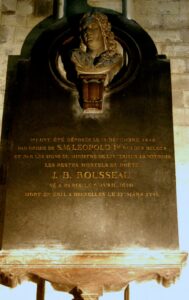
In the south transept, in front of the door leading to the sacristy, a stone marks the burial place of the poet Jean-Baptiste Rousseau (“Here lie the remains of J.B. Rousseau”). He was first buried in 1741 in the church of the Discalced Carmelites, then, when it was demolished after the suppression of the order in 1796, his remains were transferred to the Church at the Sablon. His tomb once bore the inscription:
“Here lies the Illustrious and Unfortunate
Rousseau
Brabant was his tomb
Paris his cradle.”
At the request of Leopold, the first King of the Belgians, and his Minister of the Interior, Baron Nothomb, a cenotaph was erected above the tombstone. Cenotaph is derived from the Greek words kenos (empty) and taphos (tomb). Rousseau’s cenotaph is adorned with his bust, the work of the Tournai sculptor Jean Félix Dumortier (1801-1868), and it reads:
“Here were laid to rest on 19th December 1842,
by order of His Majesty Leopold I, King of the Belgians,
and through the efforts of the Minister of the Interior, J.B. Nothomb,
the mortal remains of the poet
B. Rousseau,
born in Paris on 6th April 1670,
died in exile in Brussels on 17th March 1741.”
It was Duke Leopold of Arenberg who generously welcomed in his palace at the Sablon this genius of French literature, known as the Great Rousseau, to distinguish him from the other, presently better-known figure (Jean-Jacques Rousseau). The Prince of Savoy also granted him an annuity during his exile. This Rousseau was a celebrated lyric poet but blamed his enemies, often imaginary, for his failures. He wrote satirical and even frequently defamatory verses about them. He was banished for life in 1712 for “composing and distributing impure, satirical, and defamatory verses”.
Taking refuge in Brussels, he quarrelled with Voltaire, whom he met primarily at the Arenberg residence. In a letter that would later be included in a collection published in Paris in 1820, he reproached Voltaire for a scandal that the latter had allegedly caused during a mass at the Church of Notre-Dame au Sablon: “I cannot help but recount here how I learned of his [Voltaire’s] arrival. The Earl of Lannoy, whom I found at noon at the Marquis of Prié’s, asked me what the young man was whom he had just seen at the Church at the Sablon, and who had so scandalized everyone with his indecent behaviourduring the service that the congregation had been on the verge of throwing him out.” This playwright had a knack for getting into arguments with everyone.
After a brief return to France, he died penniless in exile in Brussels. He had invested everything in the Ostend Maritime Company, which traded with the Indies and had been liquidated in 1731 following the Pragmatic Sanction of 1713 and the second Treaty of Vienna of 1731.