

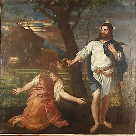
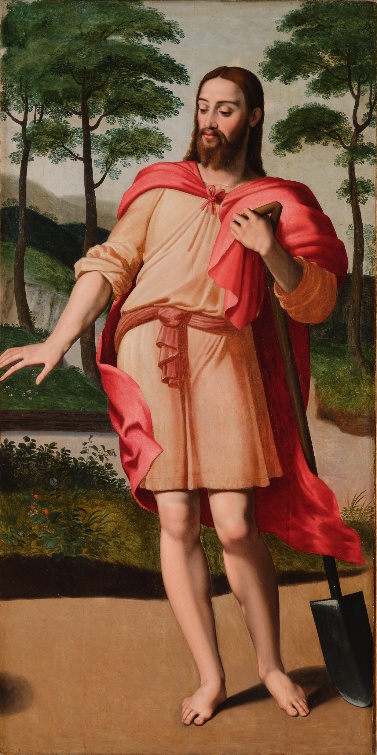
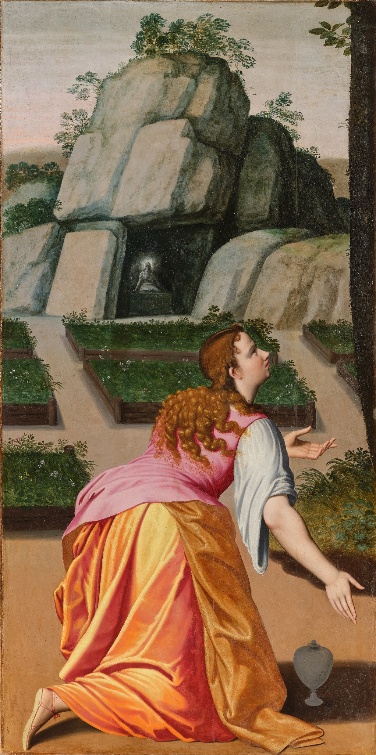
Front side of the triptych with the donors. Then the copy made by Alonso Coello of the “Noli me tangere” of Titian ordered by King Philip the second. Finally the back side of both panels which reproduces the painting.
That evening many specialists and art lovers came to the church to listen to lectures by Madame Sophie Mortier, a conservator-restorer of paintings for over 20 years, and Dr. Anne Delvingt, an art historian.
Daniel van Steenberghe, founder of the Fund of the Friends of the Church, pointed out that no fewer than six paintings had been restored in the church since 2018. This made it possible to attribute a work to Abraham Janssen or to make discoveries. “The Assumption” is painted on an underlying Protestant painting (!), and the panels of the Resurrection by Michel Coxcie have previously unknown hallmarks from the city of Brussels. Five of the six restored paintings were restored by Madame Sophie Mortier, who worked on site for nine months. She made a presentation illustrated with PowerPoint of her meticulous work.
By removing the panels from the wall, she discovered a magnificent “Noli me tangere” at the back, a work that was previously unknown and not even included in the IRPA’s photographic inventory. Dr Anne Delvingt was commissioned to carry out a research mission to identify the painter and understand the absence of the central panel.
The lack of archives made the task particularly arduous. In fact, the church was built by the Crossbowmen’s Oath, who placed the archives in their house (Maison du Roi) on the Grand-Place.
The latter burned down during the bombardment of the town by French troops at the end of the 17th century. Anne Delvingt discovered that the back was a copy of Titian’s Noli me tangere, painted for Mary of Hungary who was baptized at Notre-Dame au Sablon. The painting disappeared, but was copied on behalf of King Philip II by Alonso Sanchez Coello. Charles de Tisnacq, who worked for King Philip II in Madrid, probably saw it. The author of the triptych has not yet been identified, but experts think of a greatmaster such as Pourbus or Coxcie .